Chicken Breast Stringy Raw: Spaghetti Meat Explained
On March 21, 2024, a mother in Texas named Alesia Cooper posted a photo on Facebook.
In the photo she holds up a raw chicken breast, and the lower half of it has already come apart into fine strands, hanging down limp — like a handful of soaked spaghetti.
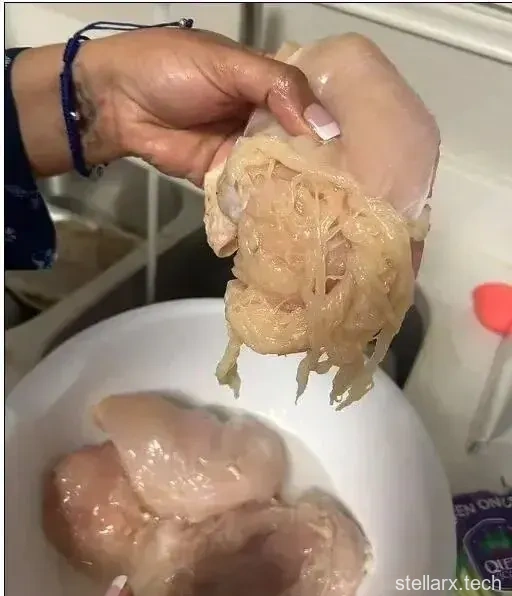
It had happened a few weeks earlier. She had brought the breast home from the supermarket to make dinner for her two children, handled the chicken the way she always did, and when she came back to put it in the pan, one piece had turned into this.
What makes it strange is that the breast had never been cooked.
Cooper could not work it out. She wondered whether she had bought some kind of artificial meat. Once the photo went online, commenters guessed that the chicken might be lab-grown, or even 3D-printed.
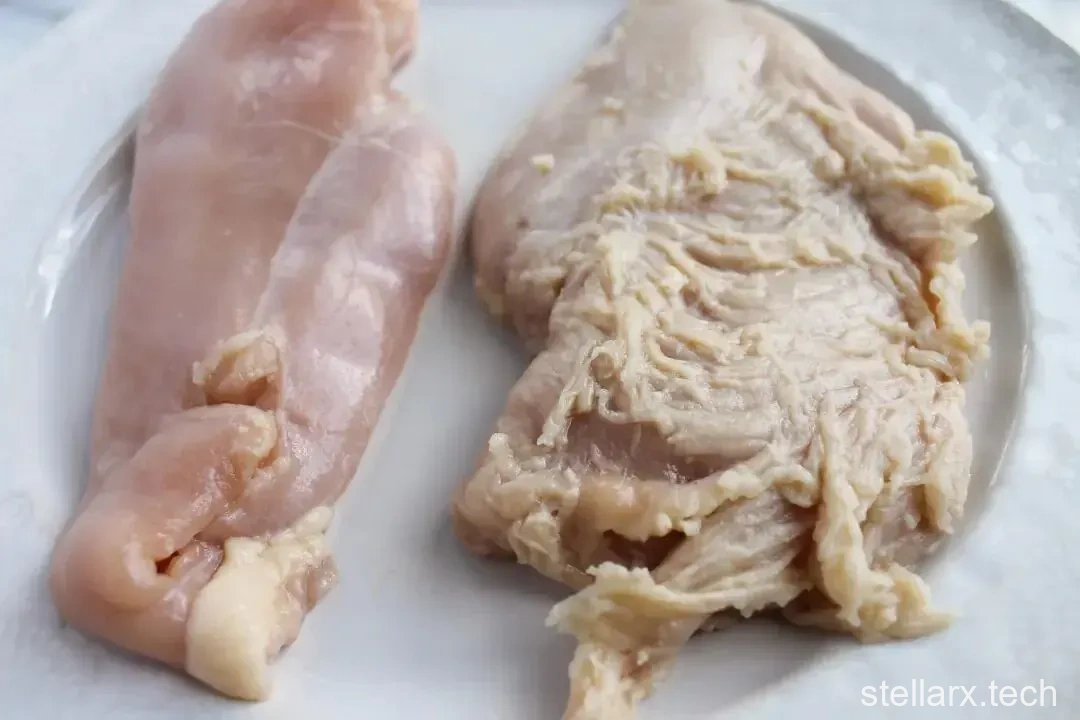
The answer, it turns out, was already on record.
In 2015, researchers reported a muscle abnormality they called "Mushy Breast." Later, because it looks so much like pasta, it was given a more vivid name: Spaghetti Meat.
| Score | Grade | Pectoralis major findings |
|---|---|---|
| 0 | Normal | Normal consistency, no sign of muscular lesion |
| 1 | Moderate | No evident superficial laceration, but a soft, stringy texture felt by pinching the cranial surface |
| 2 | Severe | Extensive superficial lacerations on the cranial and/or caudal surface; fiber bundles separate from one another, resembling spaghetti pasta |
| Grading scale for spaghetti meat in broiler breast fillets (Tushar Z H, et al. Poultry Science 2026;105(9):107224). | ||
What has happened is that intact muscle tissue has come loose on its own. The surface of such a fillet still looks fairly normal; pinch it, and you can feel the bundles inside separating. In severe cases, the fibers peel off the block in strands without any cooking at all.
When we pull cooked chicken apart for a shredded-chicken dish, the meat separates into strands along the grain. A chicken breast is built that way from the start: a large number of long, thin muscle fibers gathered into bundles, and the bundles assembled into the whole muscle. Each fiber is itself one long muscle cell.
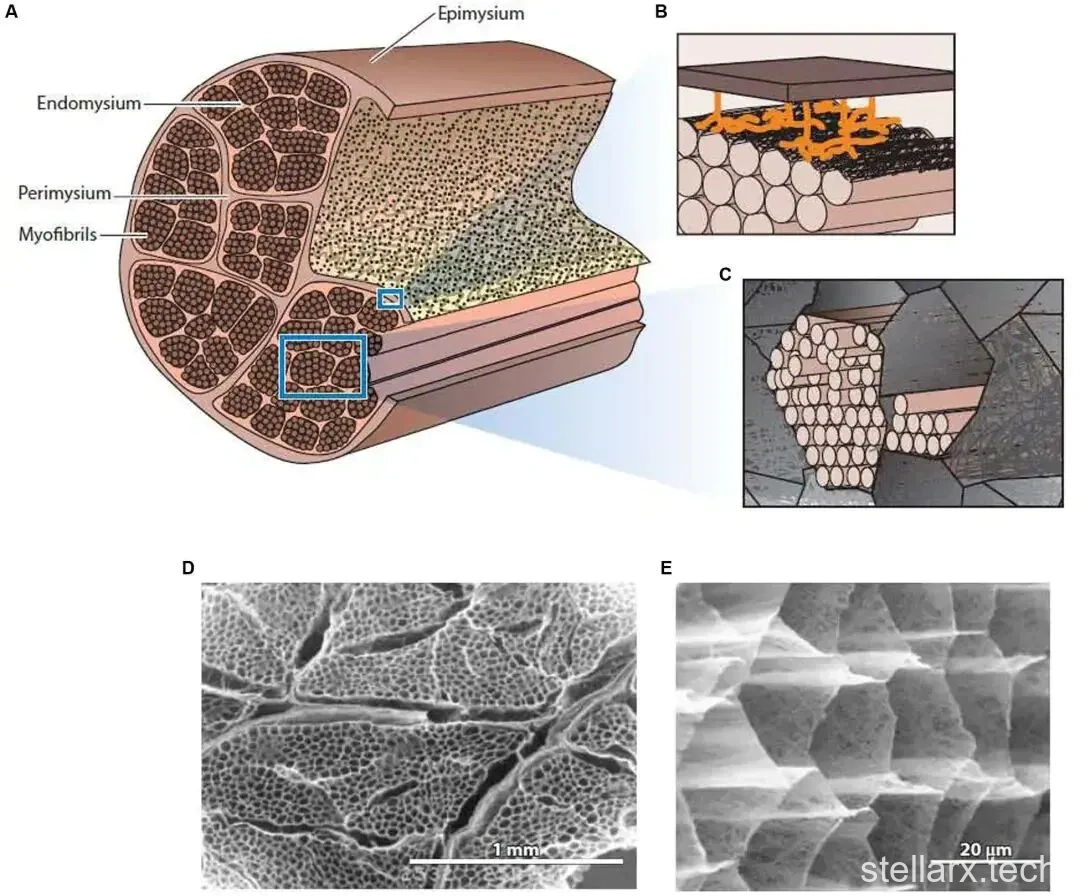
Around the fibers and around the bundles runs connective tissue, and the collagen in it forms an interconnecting net that holds many long muscle cells tightly together so they can share the pulling load.
It is a little like bundles of thread tied firmly together. Heat changes the internal structure of cooked breast, which is why you can tear it along the grain; a normal raw breast does not fall apart into a handful of noodles.
And when scientists put spaghetti meat under a microscope, they found exactly this structure failing.
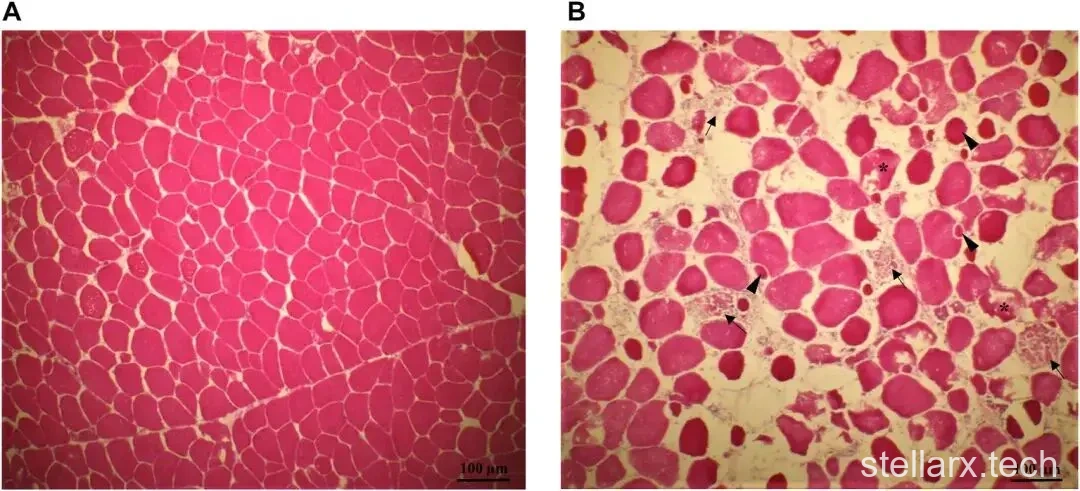
In abnormal fillets, some muscle fibers are damaged and breaking down, and the surrounding connective tissue has changed as well. Tissue that was tight has become sparse, and some collagen fibers are thin, loose, and immature.
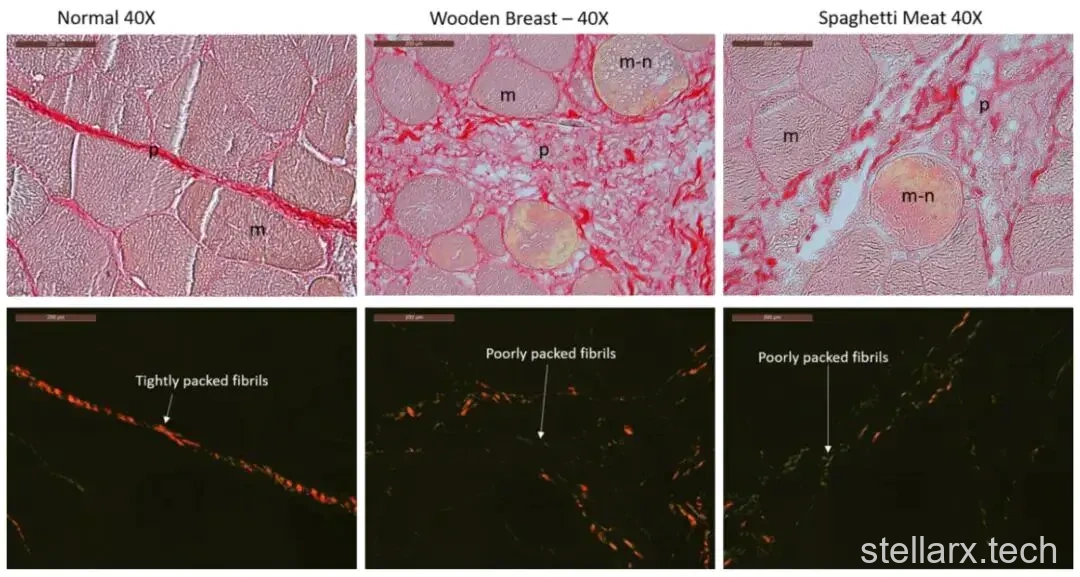
It is as if the string around the bundle has slackened: the threads are still there, but they can no longer hold together the way they once did. A breast that used to be firm then separates, strand by strand, along the direction in which the muscle runs.
So what did this to the chicken's breast muscle?
Researchers turned to the astonishing growth rate of the modern broiler.
By 2025, the average U.S. broiler needed only 47.5 days, yet reached about 3 kg.
In other words, across 100 years of breeding and husbandry, the growing period fell by more than half, while market weight became more than 2.6 times what it had been.
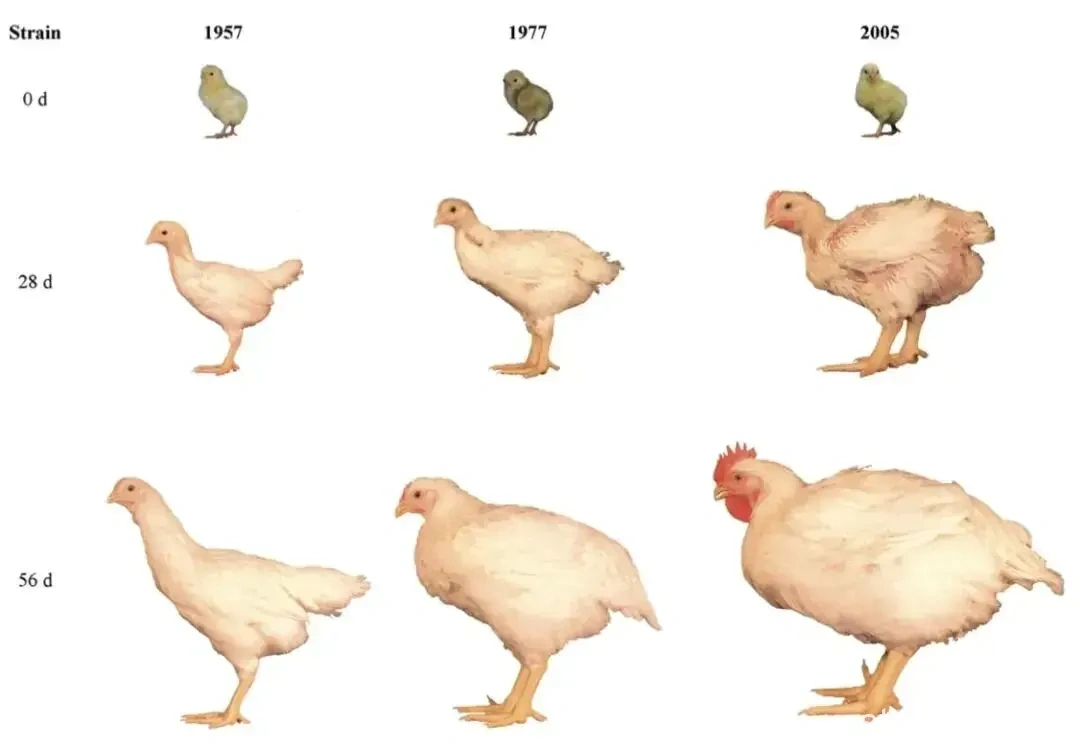
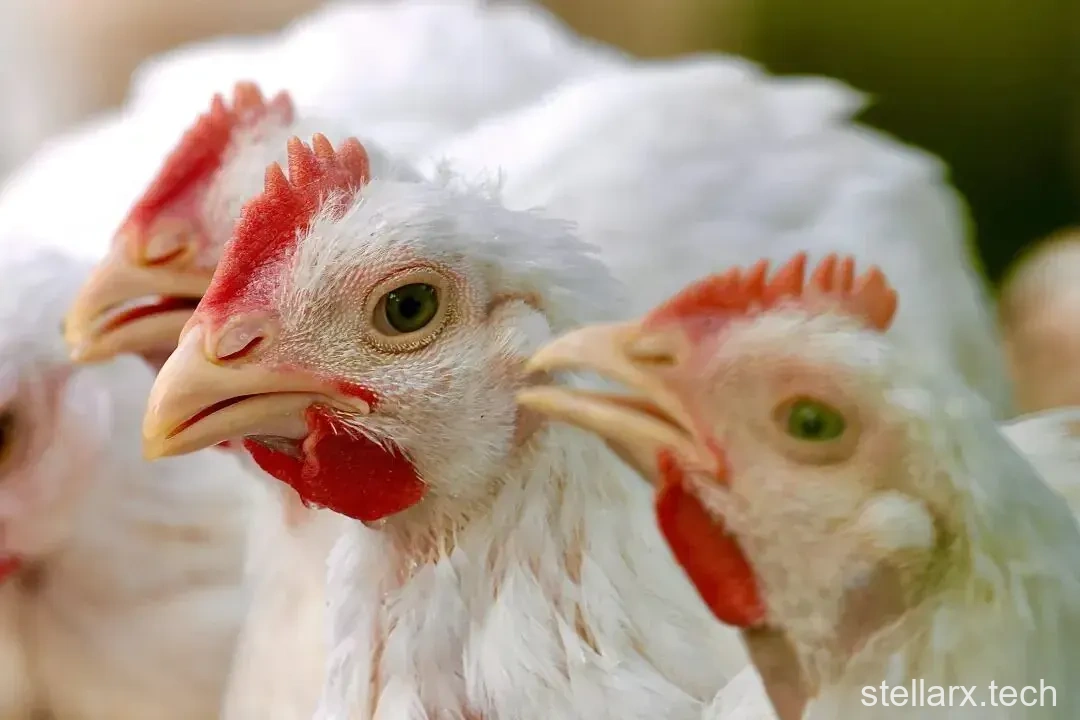
After long selection, modern broilers can grow a full breast in a very short time. But adding muscle is not simply adding weight.
As the fibers thicken quickly, the blood supply inside the muscle does not necessarily keep pace. In the thick breast region in particular, oxygen and nutrients have to travel a longer distance before they reach the muscle cells.
Scientists believe this shortfall in oxygen supply, and the metabolic stress that follows it, may be an important trigger for breast abnormalities in modern broilers.
Some fibers are damaged under that pressure, and the body immediately starts to repair the damage: immune cells clear away the damaged tissue, new fibers begin to form, and the surrounding connective tissue is rebuilt along with them.
But the repaired tissue does not always return to its original state.
In spaghetti meat, researchers are looking at exactly this altered connecting structure. Some collagen fibers are immature, insufficiently cross-linked to one another, and never re-form a network that is tight and firm enough.
As a result the muscle fibers are still lined up together, but the structures joining them have become weak. Once the breast is handled, it separates more easily between the bundles.
This imbalance between growth and repair is considered an important reason spaghetti meat forms. Why some chickens develop it and others do not, however, is still being studied.
For the past 100 years, people have kept making broilers grow faster and grow fuller breasts. But in some birds, while the muscle grew, the tissue that holds its internal structure together did not keep its old strength.
And so a chicken breast that never reached the pan came apart into a handful of noodles.
What holds a muscle together is easier to picture once you have seen it closely: collagen fibers running between bundles of muscle cells, fibroblasts packed into the gaps, a mesh that has to stay tight.
You can look at that right now, without waiting for a microscope to arrive. WWAI carries a fibrous connective tissue specimen where collagen fibers, elastic fibers and fibroblasts are clearly visible. Ask the AI tutor what you are looking at, then observe the specimen under a virtual microscope on your phone.
Search WWAI in your app store to download it.

Related reading

The Chicken's Gizzard: A Dinosaur's Stone Crusher
Why You Shouldn't Wash Raw Meat: Bacteria Splash
Botulism: Why Vacuum-Sealed Food Turns Deadly
References
Ediriweera H. Mom shares disgusting photo of chicken breast that shreds into spaghetti. Newsner, 2024-03-27. https://en.newsner.com/news/mom-shares-disgusting-photo-of-chicken-breast-that-shreds-into-spaghetti/
Baldi G, Soglia F, Mazzoni M, et al. Implications of white striping and spaghetti meat abnormalities on meat quality and histological features in broilers. Animal, 2018, 12(1): 164-173. doi:10.1017/S1751731117001069
Baldi G, Soglia F, Petracci M. Spaghetti meat abnormality in broilers: current understanding and future research directions. Frontiers in Physiology, 2021, 12: 684497. doi:10.3389/fphys.2021.684497
Sanden K W, Böcker U, Ofstad R, et al. Characterization of collagen structure in normal, wooden breast and spaghetti meat chicken fillets by FTIR microspectroscopy and histology. Foods, 2021, 10(3): 548. doi:10.3390/foods10030548
Tushar Z H, Barbut S, Naeem M, et al. Spaghetti meat and gaping in broilers: emerging myopathies challenging poultry meat quality and processing. Poultry Science, 2026, 105(9): 107224. doi:10.1016/j.psj.2026.107224
Zuidhof M J, Schneider B L, Carney V L, et al. Growth, efficiency, and yield of commercial broilers from 1957, 1978, and 2005. Poultry Science, 2014, 93(12): 2970-2982. doi:10.3382/ps.2014-04291
National Chicken Council. U.S. broiler performance: 1925 to present. https://www.nationalchickencouncil.org/about-the-industry/statistics/u-s-broiler-performance/
- 為什麼哺乳動物都有七塊頸椎?長頸鹿與霍加狓的同一副脖子
- Why Almost Every Mammal Counts Seven Cervical Vertebrae
- 肉雞生長速度翻倍,雞胸肉散成麵條的真相
- Chicken Breast Stringy Raw: Spaghetti Meat Explained
- Inguinal Hernia: A Groin Bulge Mistaken for a Muscle Strain
- 腹股溝疝氣:產後健身鼓起的腫塊,卵巢掉進去了
- Four Days of High-Fat Diet Can Rewrite Skin Immune Memory
- 高脂飲食 4 天,皮膚發炎為何更猛、還記得住?
- 脂肪肝盛行率:中國每10個成人有3個
- Fatty Liver Overtook Hepatitis B: 3 in 10 Chinese Adults
全部评论