Why Can't Small Vertebrates Replace Insects?
A hummingbird and a bumblebee are almost the same size. Both feed on nectar, hover in the air, and defend themselves in the same garden. But the bee has roughly 500 species behind it and its relatives swarm the planet, while the hummingbird manages barely 300 — and is the only bird that can even hover at that size.
Size for size, the vertebrate brought a fancier nervous system and a better respiratory system to the fight. And lost.
So what stops a vertebrate from shrinking into the insect niche? The answer runs through five hidden walls: breathing, nerves, armour, metamorphosis, and wings.
Wall 1: Breathing — the Blood Gets Skipped
Birds perfected the vertebrate respiratory system. One-way airflow, air sacs, the works. The "dragon" lineage, as one zoology post puts it, reached the ceiling of breathing through blood.
Insects walked away from the entire blood-carrying step.
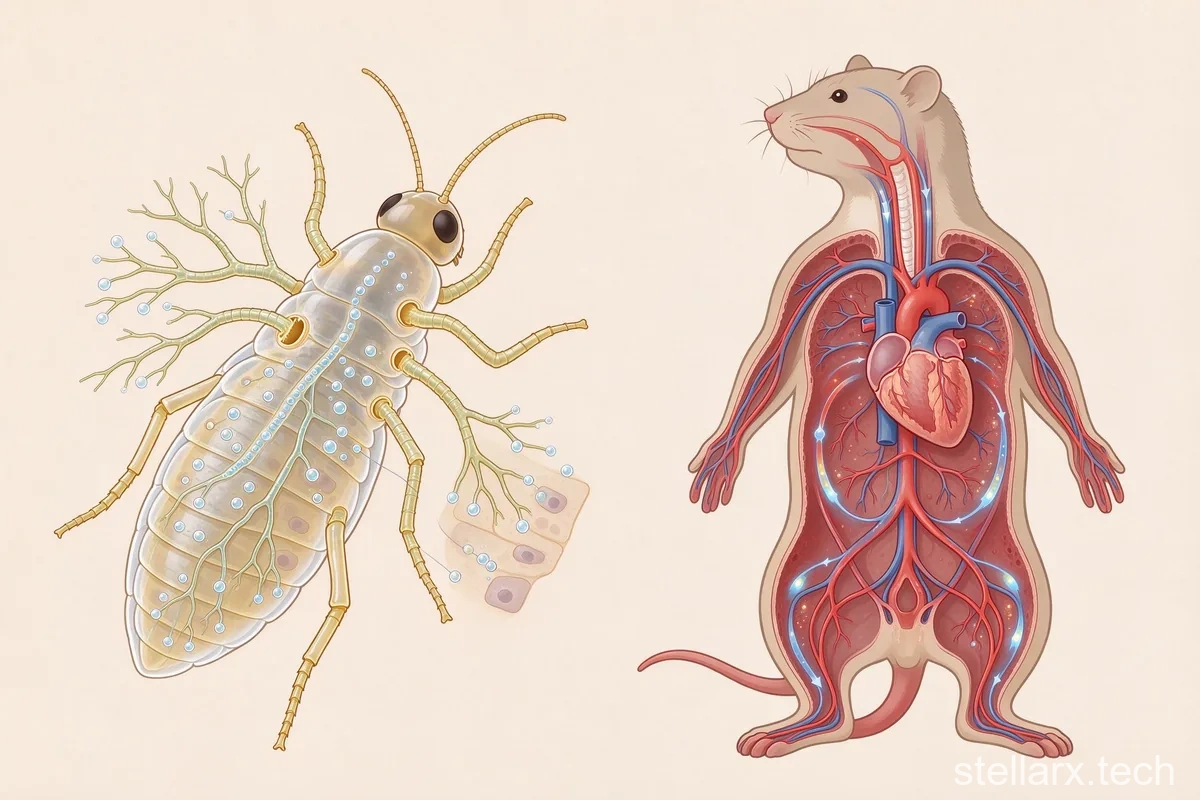
An insect's tracheae — branching air tubes — deliver air directly to the cells. Oxygen doesn't ride in red blood cells pumped through a circulatory system; it diffuses straight to the tissue that needs it. No heart pumping hard to deliver oxygen; no capillaries. The tube itself is the delivery network.
For a small animal, this is the single biggest gift: oxygen supply does not shrink with the animal. A big insect still breathes this way, because the system scales down beautifully.
Then comes the water trick. A diving beetle grabs an air bubble and can stay underwater for hours. A killer whale, the champion of vertebrate divers, holds for about 17 minutes. An eastern newt of roughly the same size as that beetle? Around 5–10 minutes.
Insects can also shut their spiracles — the opening valves of the tracheal system — to stop water from leaving the body. Vertebrates of similar size, no matter how well they breathe, still have to carry the blood and the pump everywhere they go.
[
Wall 2: Nerves — the Slow Wire That Wins When Small
Compare brains at equal size. A hummingbird carries roughly 250 million neurons. A bumblebee of the same size carries about 1 million. Ten million would not be a typo — it's 250 times fewer.
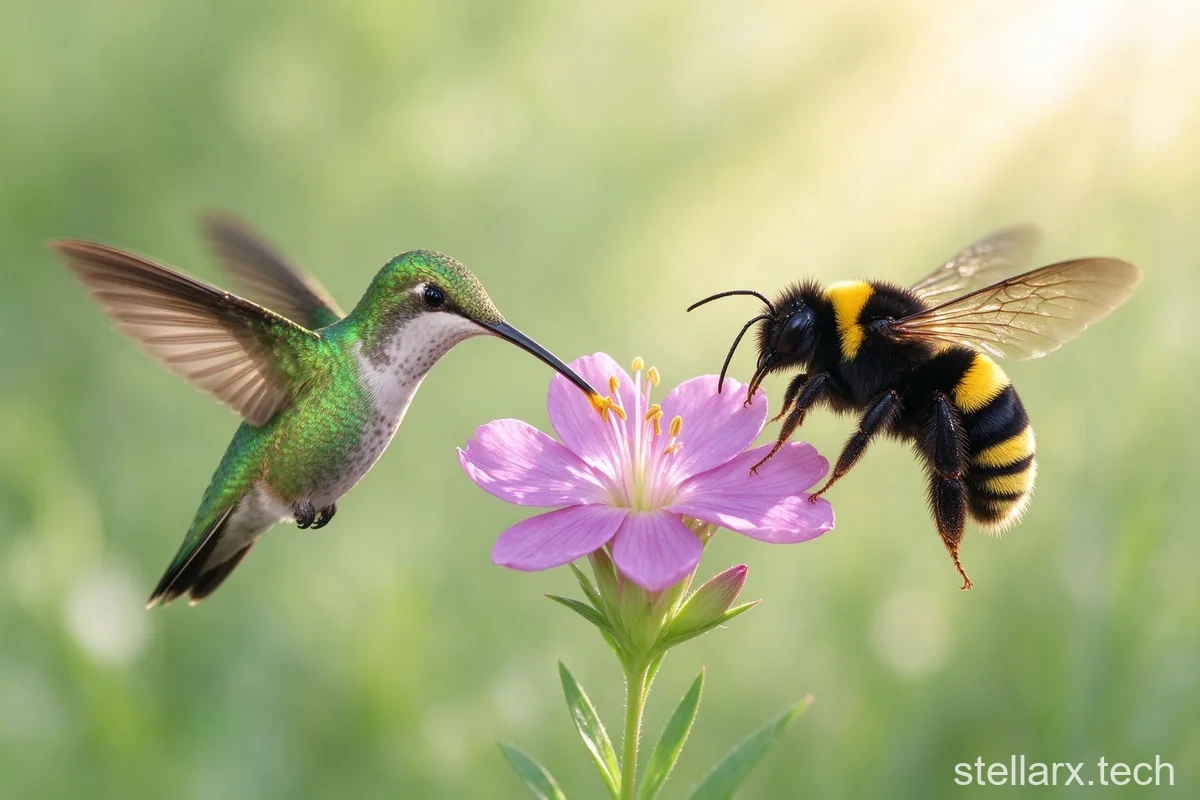
Yet the bumblebee holds an equivalent ecological niche and its family is more successful than the hummingbird's. Big brains are not the point at this scale.
The reason is wiring. Vertebrate nerves are wrapped in myelin, a fatty sheath that lets signals travel at 50–120 m/s. Unmyelinated nerves crawl at 1–5 m/s; the fastest arthropod pseudo-myelin (a giant squid axon) reaches about 200 m/s.
For a big body, speed matters — a giraffe's leg must hear from the brain without a half-second lag. For a body measured in centimetres, the delay difference is 0.01 s vs 0.0002 s — nothing. The animal reacts in the same blink either way.
What the slow wire buys is space. Unmyelinated nerves take less room per signal, so an insect can pack far more wiring into a tiny head. An ant's brain, as a share of body mass, is roughly average for a vertebrate. It's not a shrunken vertebrate brain — it's a different trade: hundreds of cheap slow wires instead of one expensive fast one.
That also explains the legs. A tiger beetle — one of the fastest animals per body length on Earth — runs on six absurdly slender legs. Compare its limbs to a newt's and the newt looks built for a different weight class: thick limbs, heavy skeleton, blood to pump.
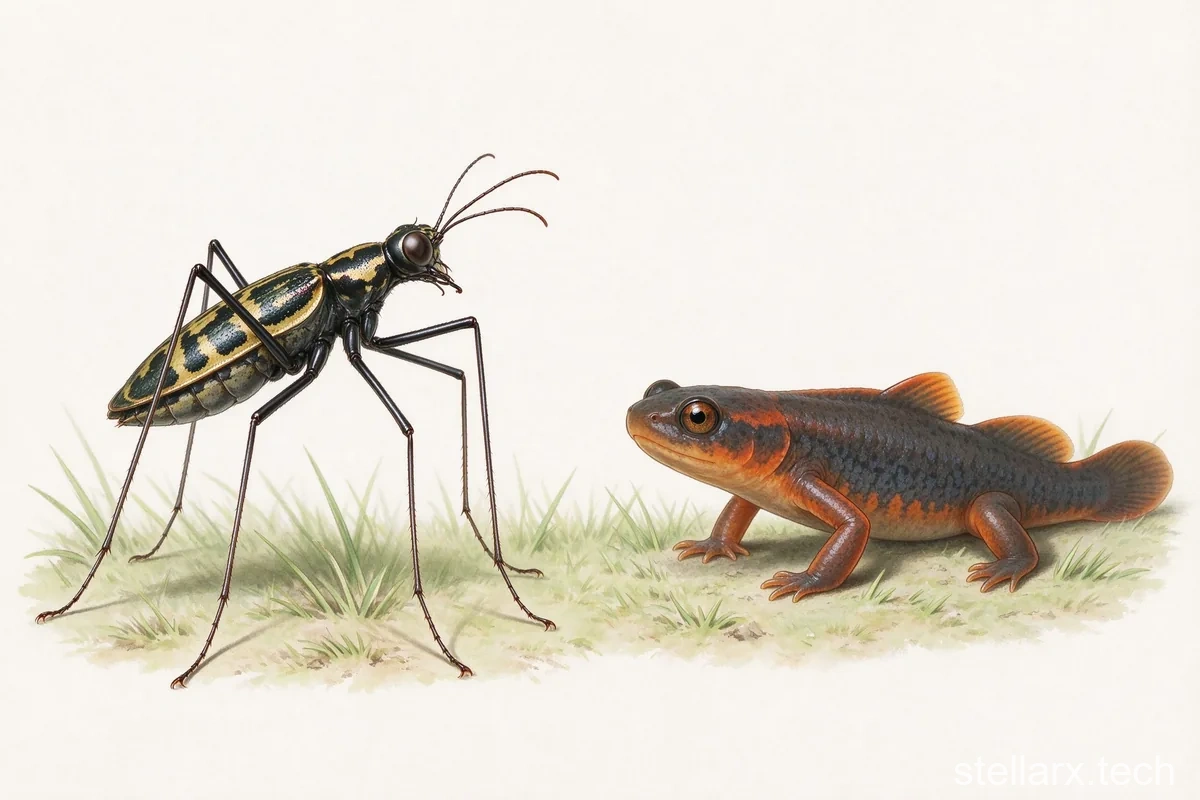
And the nervous system itself is decentralised. An insect's "brain" is more like a chain of low-cost calculators strung together, each segment running its own routine. A vertebrate's centralised brain is a supercomputer — but a supercomputer pays a heavy wiring and power tax. When the body is small, the chain of calculators wins.
Wall 3: Armour, Wax, and Digestion — Building Small Is Expensive
Vertebrates have an internal skeleton, which sounds like the small-animal-friendly option. But the external skeleton of an arthropod is a different bargain.
An exoskeleton gives an insect armour, waterproofing, and muscle anchors — but it must be shed to grow. Layer on thicker armour and you pay in moults. Vertebrates never moult; they just grow. So why don't small vertebrates take over with their growable bones?
Because at small size, the exoskeleton wins on defence per gram. A tiny vertebrate's skin is easy prey; an insect is a box. Some vertebrates improvise — an eastern newt stacks wax in its skin and adds venom glands, an amphibian building its own armour. But it costs them energy that an insect's chitin doesn't.
Feeding favours insects too. Many insects digest outside the body — spitting digestive fluid onto food and sipping the soup. No bulky stomach, no heavy gut to carry. Vertebrate herbivores are so inefficient that rabbits eat their own faeces to extract more nutrition. The small-animal niche belongs to the animal that doesn't need to carry its digestion machinery everywhere.
Wall 4: Metamorphosis — the Ultimate Cost-Cutting
Here is the deepest trick, and the most underrated. The four most successful insect orders — beetles (Coleoptera), butterflies (Lepidoptera), flies (Diptera), and wasps/ants/bees (Hymenoptera) — are all holometabolous: complete metamorphosis.
A holometabolous insect splits its life into two phases with zero wasted investment. The larva eats. The adult reproduces and spreads. The larva doesn't need wings, compound eyes, a hard shell, or a wasp waist — it's a mouth and a stomach on legs. The adult doesn't need to grow. Each phase carries only the organs it uses.
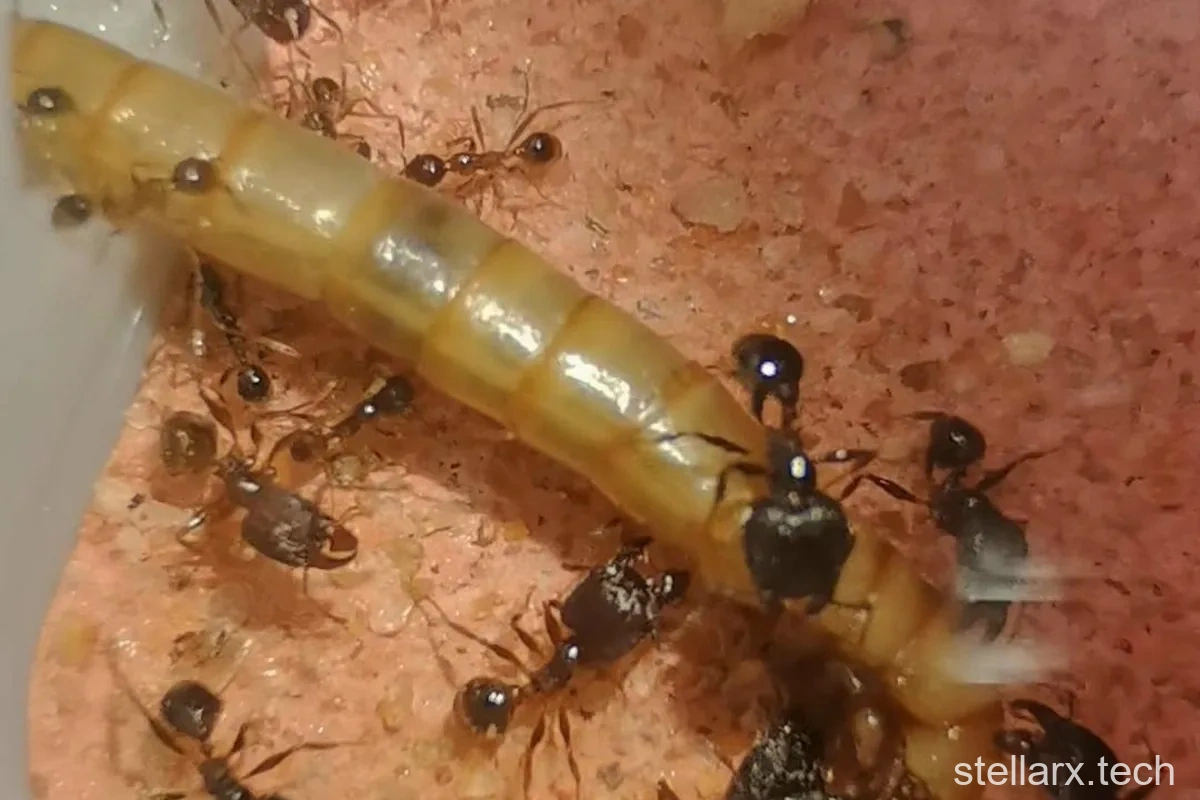
An ant colony shows the trick in action. Ant larvae are soft, pale, helpless grubs — no shell, no legs worth mentioning, no antennae, no waist. A termite, by contrast, goes through incomplete metamorphosis: its nymphs look like small adults from day one, paying the full body-building bill for the whole larval phase.
Watch a rearing box and you'll see the difference. Termite workers and ant workers fill the same role, but the ant does it with larvae that cost almost nothing to produce — "an optimised cost-cutting pipeline," as one breeder's notes put it.
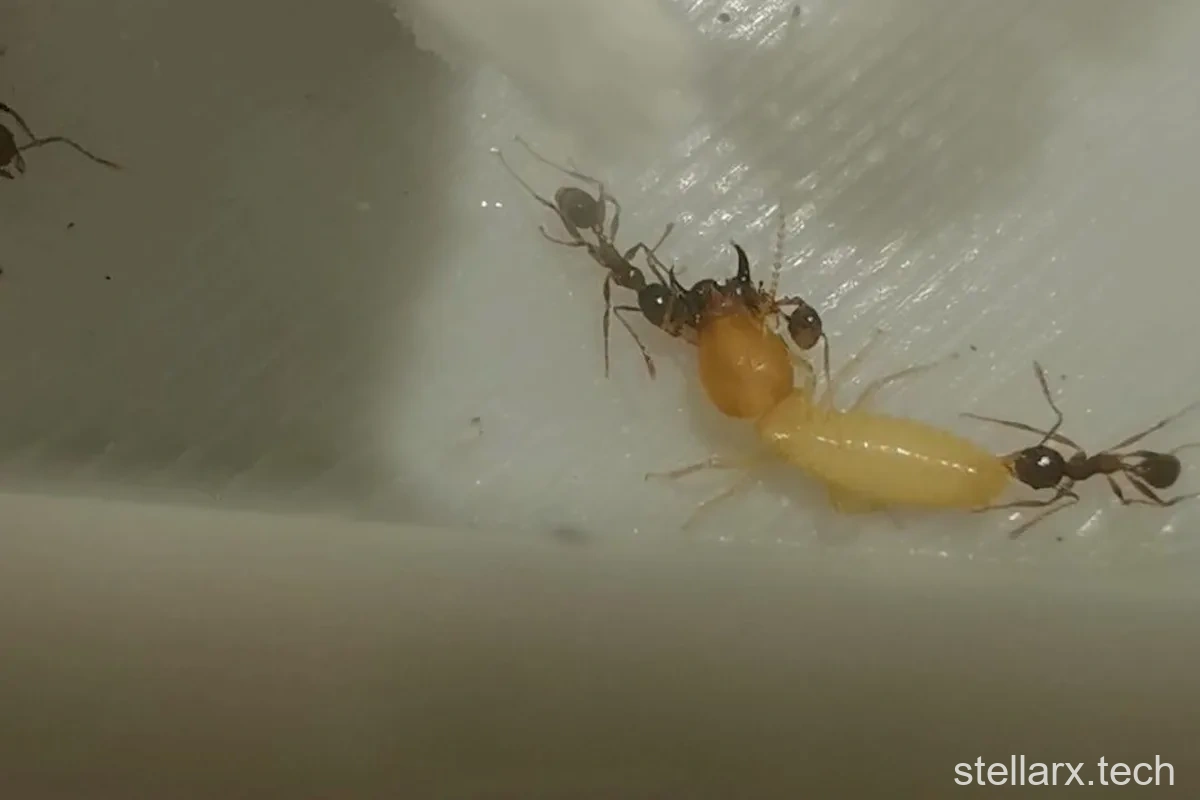
Both scenes come from the same kind of rearing box — live colonies, front-row seats to the difference. The ants' larvae never had to build a working adult body on the way up.
Wall 5: Wings — Without Sacrificing a Pair of Limbs
Look at the names of the great insect orders: Coleoptera, Lepidoptera, Diptera, Hymenoptera. Almost every one carries "wing" in its name. Wings are the default for insects — the founding contract of the group.
Vertebrates bought wings at an enormous price. A bat sacrificed its forelimbs; a bird sacrificed its forelimbs and rebuilt its whole skeleton. One pair of limbs, gone, for flight.
Insects never paid that. Their two pairs of wings grew on top of the six legs — no limb was sacrificed. The insect gets six walking legs and wings, the helicopter option; the vertebrate gets the fixed-wing option, trading mobility on the ground for wings in the air.
Even the ability to give wings up is a feature. Wingless aphids don't grow wings when they stay home; ant reproductives and alates grow them only for the mating flight. A vertebrate can't switch flight on and off — once a wing skeleton, always a wing skeleton.
Scale this down and the wall appears: the smallest flying vertebrate is the hummingbird, and the smallest snakes and shrews hover around insect territory — but only the upper range of insects. Below that, the vertebrate body plan simply runs out of room for lungs, a heart, bones, and a heavy central nervous system, all at once.
The Niche Was Never a Hierarchy
Insects are not "lower" animals that happen to survive. They are animals that traded vertebrate luxuries — myelin speed, centralised brains, internal skeletons — for space efficiency, metamorphic cost-cutting, and wings that cost nothing. In their own niche, those trades are not compromises. They are the winning hand.
The world itself refuses the idea of a ladder. Plant biomass makes up about 82% of all living biomass; animals are roughly 0.4%. And when mass extinctions hit, the top of the food chain dies first, not the insects at the base. The niche is not a ranking. It's a set of rooms, and insects rent the smallest ones — permanently.
Ever wanted to see for yourself what insect hardware looks like up close — the wing scales of a butterfly, the sculpted plates of an ant? With WWAI you can observe them now — no microscope delivery, no slides to prepare. A real biological specimen is on screen the moment curiosity strikes, including a butterfly wing specimen where scale rows and vein patterns are clearly visible. Ask the AI what each structure does, and zoom in on the microscopic engineering inside insects. Search "WWAI" in your app store and download it today.
Related reading

Why Are Mysterious Round Holes Appearing on Parked Cars? The…


- Why Do Mouth Wounds Heal So Fast? The Mouth's Secret
- 嘴破為什麼好得快?口腔傷口的隱藏機制 | stellarx
- 為什麼小型脊椎動物取代不了昆蟲?
- Why Can't Small Vertebrates Replace Insects?
- 生肉到底要不要洗?小心水花飞溅,让致病菌污染整个厨房
- Off-Topic Answers Reveal the Question Behind the Question
- 每個答非所問的背後,都有一個還沒問出口的問題
- Are Earthworms Good for Your Garden? The Truth
- 蚯蚓塔堆肥是福是禍?蚯蚓糞的隱藏缺點一次看清
- Why Do Couples Look Alike? Assortative Mating Explained
全部评论