Direct Imaging Exoplanets: JWST's Twin Finds 51 Eri b
Exoplanets would be a lot easier to find if so many of them weren't so close to their stars. But they are, and that's something exoplanet scientists have to contend with. Coronagraphs do great work blocking out starlight and making dim planets more visible, but they have their limitations.
JWST has coronagraphic capabilities embedded in its NIRCam (Near-Infrared Camera) and MIRI (Mid-Infrared Instrument). Those capabilities have helped the telescope study some tough subjects hidden in the glare of stars, debris disks among them, and to observe extremely luminous objects like quasars.
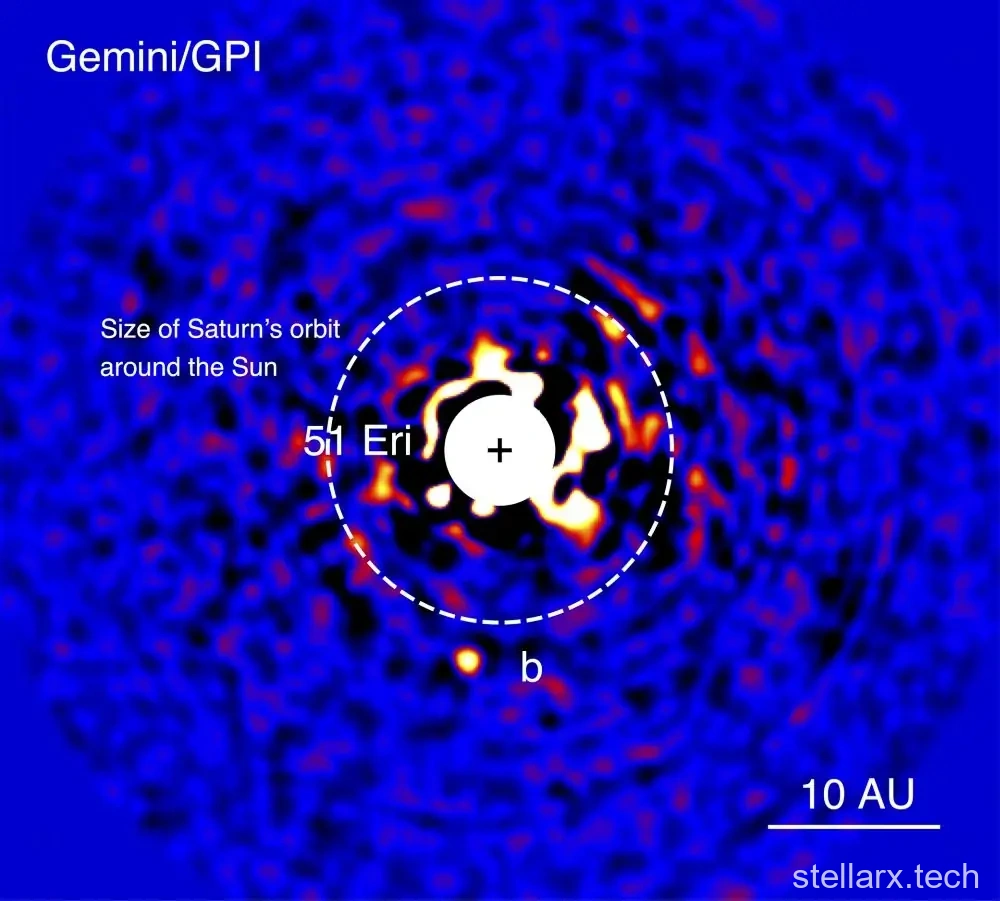
But all telescopes have a stability limit, even the steady-eyed JWST. The stability limit is a threshold beyond which mechanical, thermal, or optical fluctuations make clear images impossible. JWST has fine guidance sensors and a 5-layer sunshield to raise this threshold, but the limit is still there.
New research in Nature explains how astronomers developed a way to subtract more starlight from JWST's observations and image exoplanets that are up against the telescope's limits. It is titled "Imaging exoplanets below the telescope stability limit," and the lead author is Rodrigo Ferrer-Chavez, a graduate student in the Department of Physics & Astronomy at Northwestern University.
"Exoplanet imaging is the main method for detailed characterization of planets orbiting beyond 1 au (astronomical unit) but it requires suppressing the bright glare of the star to see the faint planet light," the authors write. Suppressing that glare requires a couple of things, including extremely stable telescopes.
"We try to make telescopes extremely stable, but there are extreme engineering challenges that we haven't quite solved yet," said study co-author Jason Wang, assistant professor of physics and astronomy at Weinberg College of Arts and Sciences at Northwestern. "There are known causes of instability and unknown causes. Small thermal changes could cause a mirror to expand or contract by a picometer. Telescopes like JWST have cryocoolers to keep the instrument super cold. Those coolers have little motors that can cause the mirrors to vibrate. So, there are issues like those, but also issues that we still don't understand as we learn how to build these complex telescopes."
But a stable telescope is only part of the picture. Image processing plays a huge role in modern astronomy, and the two factors, telescope stability and image processing, play into each other.
"As well as sophisticated instrumentation, effective image processing is necessary for starlight suppression, which continues to be a substantial limitation," the authors write.
There are standard algorithms that astronomers employ to overcome this limitation, including using reference images to model starlight.
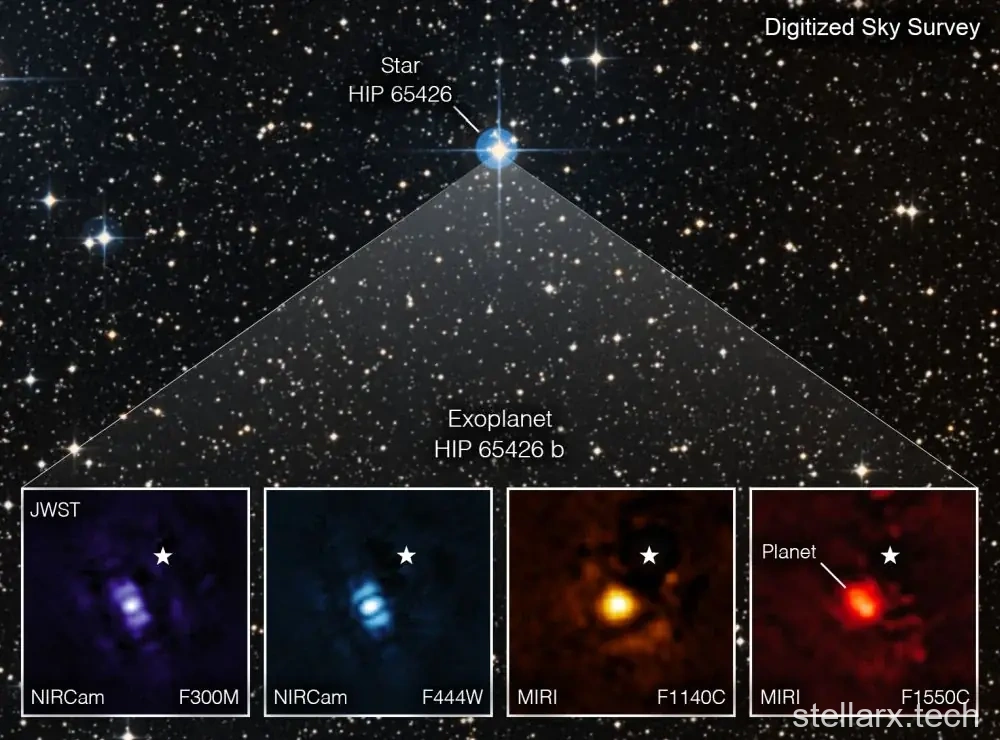
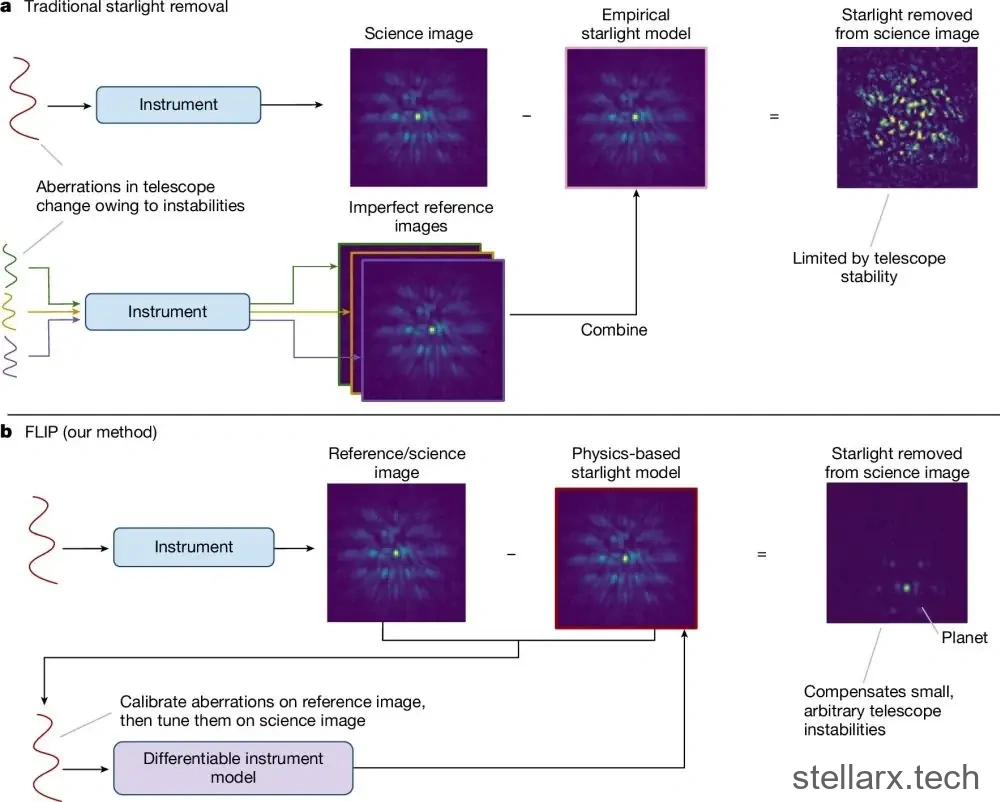
"For the past 20 years, astronomers have tackled this problem by observing a different star and using its image as a reference," said Wang. "Then, they subtract that reference image from the original observation to remove the unwanted glare to reveal faint planets that otherwise might be hidden."
But reference images have their limits too. That method still suffers from the inevitable instabilities in a telescope that arise when switching from a reference image to an actual observation. Overcoming these stubborn obstacles will mean we can directly image more exoplanets.
"Addressing this challenge will increase the number of planets amenable to direct imaging and will be a notable step towards imaging exo-Earths with future observatories," the researchers explain.
Their answer is a new method based on physics and modelling that also borrows ideas from machine learning. It can account for JWST's tiny, nanoscale imperfections. The method lets astronomers subtract starlight from images more effectively than ever before.
"Planets are a million times fainter than their stars," said lead author Ferrer-Chavez. "So, to image exoplanets, we need to remove that glare. That is a very tricky problem because even the tiniest changes in the telescope can affect how that glare appears. Slight shifts or tilts — even on the scale of just a few nanometers — can change the pattern of light. Our method models how light travels through the telescope and accounts for those tiny changes, allowing us to remove the glare much more precisely."
This comes down to PSF, the point spread function. Every telescope detects light imperfectly. They all distort or bend light in some way. So instead of a point source appearing as a point, it inevitably is degraded somehow. That can hide extremely dim sources like exoplanets in the glare of their stars. Accounting for PSF is a work-a-day part of astronomy.
The new system is called FLIP, for Physics-based Learning for Imaging Planets, and it overcomes the problem of switching from reference images to real observations. FLIP "incorporates a multistep optimization strategy with a flexible physical model informed by wavefront sensing data to achieve the PSF fidelity necessary for real data," the authors write.
That is more technical detail than many will find interesting. But this type of work is behind the gorgeous images and fascinating discoveries in astronomy.
In essence, the researchers created what they are calling a "digital twin" of JWST with FLIP. The twin reproduces how light travels through JWST down to the smallest detail. It includes subtle shifts, distortions and imperfections. They repeatedly adjusted FLIP until it matched JWST's real observations, including the polluting starlight. After that, they subtracted the star's glare from the image.
And it worked.
They tested it on 51 Eridani b, an exoplanet found with ground-based telescopes. The usual image processing techniques couldn't see the exoplanet hidden in the glare when observed at the wavelength JWST uses to find CO2 in exoplanet atmospheres. They chose that wavelength because it is a critical part of JWST's job, and a sort of sweet spot in its capabilities.
But when the researchers used FLIP, the planet came into view.
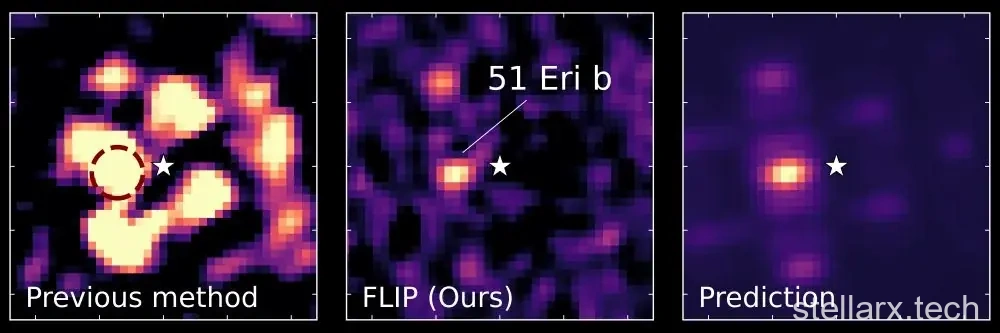
"We achieve sensitivity 2-15 times superior to standard techniques, including the first detection of 51 Eridani b at 4.3 μm," the authors write. "This is the first time, to our knowledge, that such an approach has demonstrated substantially improved sensitivity on real, on-sky coronagraphic imaging."
"We showed that we can actually recover a planet that people previously couldn't see," said Wang. "This is real data in a real scenario. It was science left on the table because we didn't have the right tools to analyze the data in the most optimal way."
FLIP seems to have a bright future. Not only with JWST, but with other space telescopes like the Habitable Worlds Observatory. Imaging exo-Earths with HWO, for example, will require extreme stability, and FLIP might get us there. In fact, FLIP might make HWO easier to design and build.
"In this work, we have shown sensitivity beyond the stability limit in JWST NIRCam," the authors write. "If this can be extended to HWO contrast levels, the ultrastability requirement for the system may be partially lifted, with the error budget necessary for image post-processing being reduced, and thus the design of the observatory may become more tractable."
In short, FLIP can take some of the pressure off the engineering challenges of building more and more powerful telescopes, and can help overcome their stability limits.
"We know of no planets around other stars that are like those in our own solar system," Ferrer-Chavez said. "It's not that they don't exist. It's that we cannot see them. Every time we improve our techniques, we discover new types of planets. By finding more planets, we can better understand how planetary systems form and evolve, and ultimately how typical our own solar system truly is."
Recovering 51 Eridani b took a model of the whole telescope, tuned until light in software behaved exactly as it does in orbit. That is how a hidden object becomes visible again. WWAI's virtual microscope works on the same idea with living material: it renders an insect compound eye specimen in which the array of tiny lenses, the corneal facets and the pigment cells are clearly visible, and you can ask questions about cells while you observe. Search WWAI in your app store to download it.
Related reading

IceCube Neutrinos Win the 2026 Nobel Prize

IceCube Neutrino Detector: Ghost Particle Hunter
References
Ferrer-Chavez R, Wang JJ, Bouman KL, Freeman WT, Pueyo L, Feng BY, Perrin MD. Imaging exoplanets below the telescope stability limit. Nature. 2026;659:58–62. doi:10.1038/s41586-026-11213-z
Macintosh B, Graham JR, Barman T, et al. Discovery and spectroscopy of the young Jovian planet 51 Eridani b with the Gemini Planet Imager. Science. 2015;350(6256):64–67.
NASA. James Webb Space Telescope: NIRCam near-infrared camera. NASA Science. https://science.nasa.gov/mission/webb/
- Inguinal Hernia: A Groin Bulge Mistaken for a Muscle Strain
- 腹股溝疝氣:產後健身鼓起的腫塊,卵巢掉進去了
- Four Days of High-Fat Diet Can Rewrite Skin Immune Memory
- 高脂飲食 4 天,皮膚發炎為何更猛、還記得住?
- 脂肪肝盛行率:中國每10個成人有3個
- Fatty Liver Overtook Hepatitis B: 3 in 10 Chinese Adults
- "Can you change the male lead to Zhou Jin?" — Female-lead melodrama audiences no longer settle for the answer you hand them
- 「能不能把男主改成周進」:女頻虐戀的觀眾,已經不滿足於看你給的答案
- Can you work overtime?" — 646 likes demanding the next episode, and the creator answered with something colder
- 「你能不能加班啊」:646 個讚在催更,作者回了一句更冷的

全部评论