Giant Virus, Euglena, Volvox: Three Unclassifiable Lives
Yes. Three of them, and they fail in three different ways.
The first one was mistaken for a bacterium and left in a fridge for ten years.
The virus that spent a decade filed as a bacterium
In 1992, British scientists collected water from a cooling tower and found a particle inside an amoeba. They stained it with Gram's method, it came up positive, and they reasonably concluded it was a bacterium. They put it in a refrigerator and moved on.
It stayed there for ten years. In 2003, a team at the University of Marseille re-examined the sample and found that it was not a bacterium at all. It was a virus, and an unusually large one.
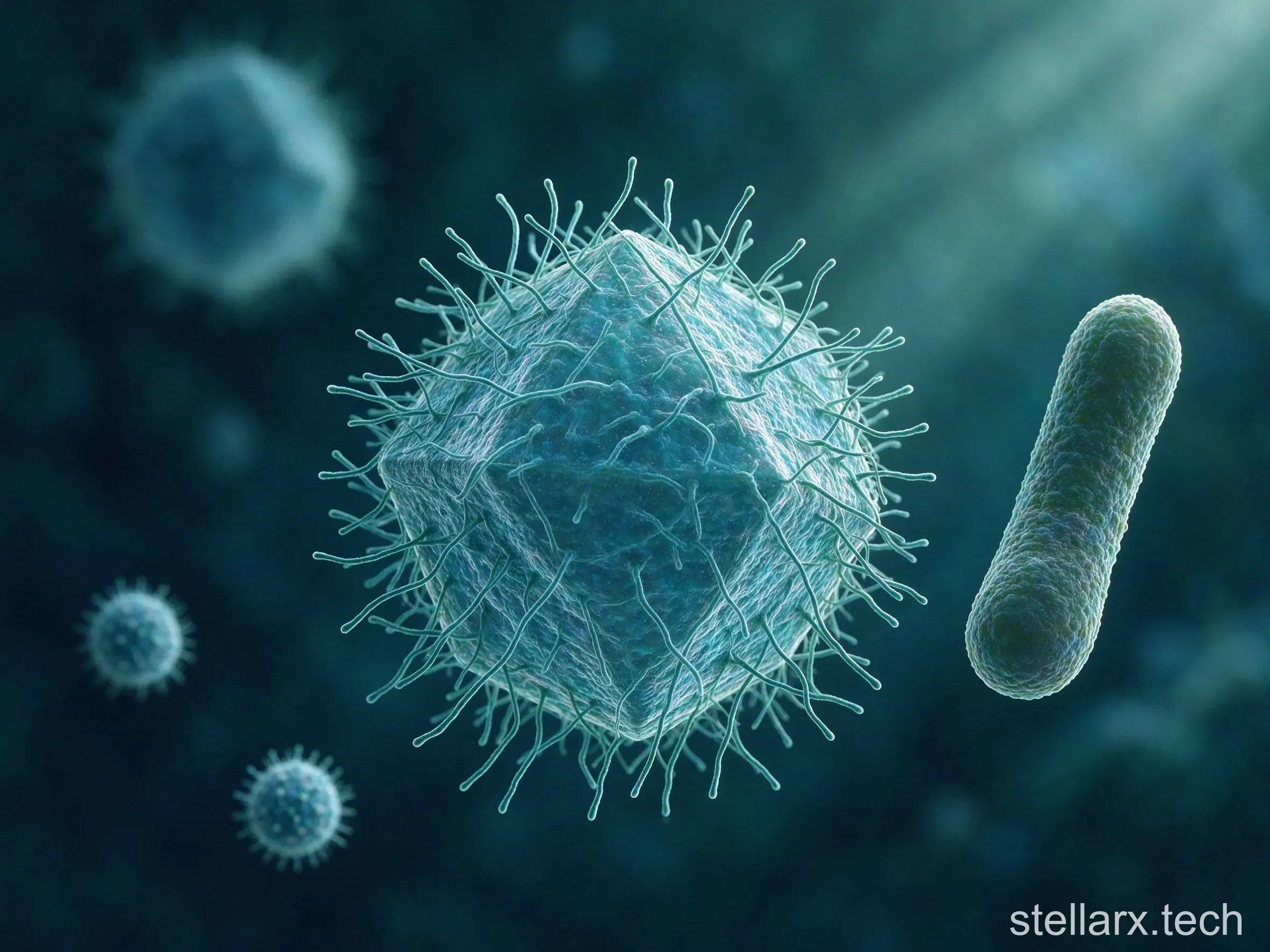
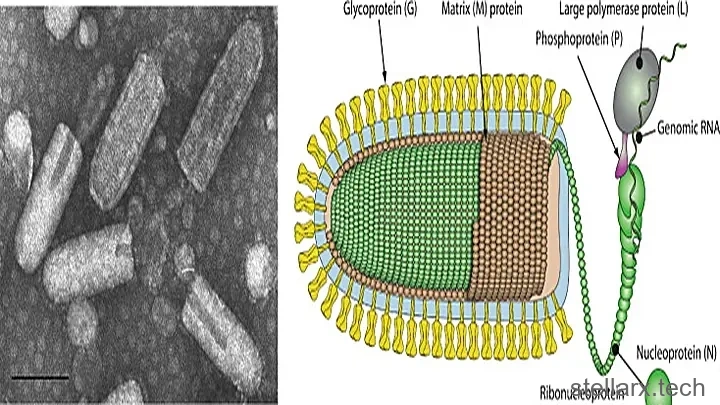
They named it Mimivirus, because in size and staining behaviour it mimicked a bacterium so well. Its diameter is close to 750 nanometres. An influenza virus is roughly 100 nanometres; a bacteriophage is smaller still. Mimivirus is larger than plenty of bacteria, big enough to be seen with an ordinary light microscope.
Its genome runs past 1.2 million base pairs and codes for more than 900 proteins. For a virus that is an astronomical figure. Influenza carries about 13,000 base pairs. HIV carries around 10,000.
A virus that brought its own repair kit
The standard account of viruses is absolute parasitism. A virus has no metabolic machinery of its own. Once inside a host cell it borrows the host's ribosomes to translate proteins and the host's energy supply to drive its own replication.
Mimivirus does not quite fit that account. Its genome contains its own DNA repair enzymes, genes involved in transcription, genes for building certain amino acids, and even some genes that take part in translation. It still has no ribosome of its own. But what it does carry goes well past what anyone expected a virus to carry.
Pandoravirus: 2.5 million bases, 93% strangers
Larger giant viruses followed. Pandoravirus, reported in 2013, has a genome of 2.5 million base pairs, twice the size of Mimivirus.
The strangest part is its contents. About 93% of its genes have no homologue anywhere in the databases of known life. Nobody knows where those genes came from, or what they do.
The virus that gets infected
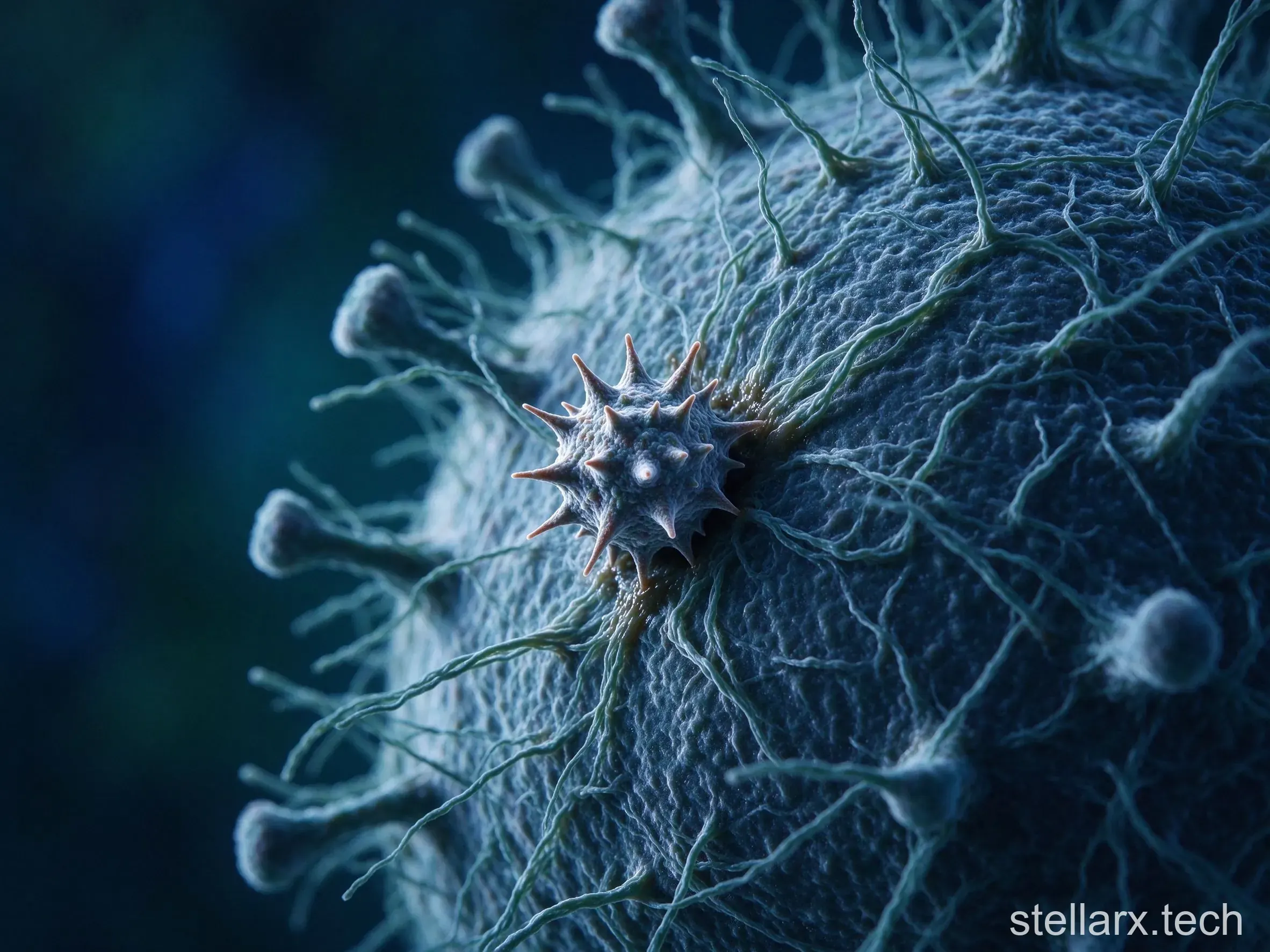
Giant viruses have one more oddity: they can be parasitised themselves. In 2008, inside the amoebae that host Mimivirus, scientists found a virus only 50 nanometres across. It does not infect the amoeba. It infects Mimivirus, using the giant virus's replication machinery to copy itself and disrupting the giant virus's own reproduction in the process.
The finding was strange enough that the researchers named it a satellite virus — something that orbits another virus. It was the first true virus of a virus that anyone had found.
Something that replicates by parasitising another organism was itself being parasitised by something that replicates the same way.
Why the tree of life has no branch for them
The taxonomic trouble follows from the biology. Viruses have never been placed on the tree of life, because they have no ribosomes, cannot make their own proteins, and have no cellular structure. Under the classical definition they are carriers of information, sitting between the living and the non-living.
Giant viruses blur that boundary. They carry metabolism-related genes, a complex set of helpers for protein synthesis, and enough complexity to be parasitised by something even smaller. In some respects they display more features of life than certain severely reduced intracellular parasites, Rickettsia among them.
One group of scientists has proposed that giant viruses represent a fourth domain of life, standing alongside bacteria, archaea and eukaryotes, descended from some primitive cellular organism that degenerated over time. Another group argues that the complex genome is mostly the result of long-term horizontal gene transfer with hosts — gene theft, repeated over and over, rather than degeneration from a more complex ancestor. That argument is still unresolved.
Euglena: a plant that swims, an animal that photosynthesises
Then there is Euglena, which has caused trouble for a different reason: it carries the core features of both plants and animals at once.
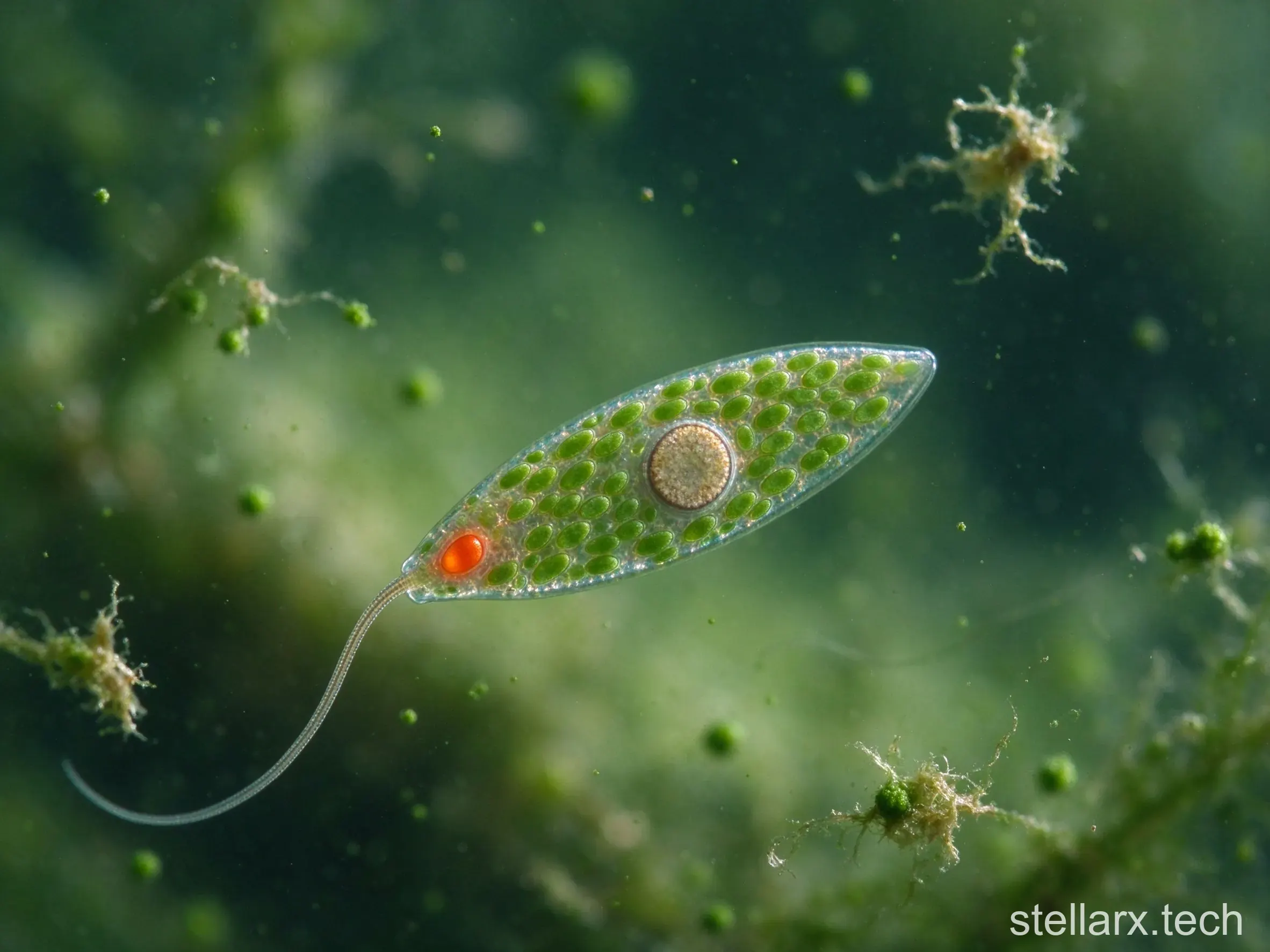
Euglena is a single-celled eukaryote, roughly 50 to 100 micrometres long, living in freshwater ponds, ditches and rice paddies — unremarkable places. Drop a bit of green pond water under a lens and the small things spiralling forward on a single flagellum are quite likely Euglena.
Its cells contain chloroplasts and can photosynthesise. Given light, it builds organic matter from carbon dioxide and water like a plant, fully self-sufficient.
That ability is supposed to belong to plants and algae. On that basis botanists treated it as a plant, placing it among the euglenoids as a branch of the algae in early botanical literature.
But Euglena also has a flagellum and swims actively, and not at random. At its front end sits a structure called the eyespot, rich in light-sensitive pigment, which senses the direction of light and steers the cell towards it. That phototactic behaviour, combined with active movement, plainly looks animal.
More importantly, when light is scarce Euglena switches strategy and turns heterotrophic, taking in organic particles from outside by phagocytosis — exactly what a protozoan does.
So zoologists considered it theirs as well, listing it among the flagellates, inside the protozoa, in early zoological classification.
For a long stretch of history, Euglena appeared in both botany textbooks and zoology textbooks.
Molecular biology eventually produced a new answer. Euglena's chloroplast was not something its ancestors always had. It was acquired through a process called secondary endosymbiosis.
Endosymbiosis in the first instance happened about 1.5 billion years ago: a primitive eukaryotic cell swallowed a cyanobacterium, failed to digest it, let it take up residence, and it eventually became the chloroplast. That is the origin of plants and green algae.
What happened in Euglena came after that. Its ancestor swallowed a green alga that already had chloroplasts, again failed to digest it, and the alga took up residence inside the Euglena cell, gradually reducing to nothing but chloroplast function.
That is secondary endosymbiosis, and the result is that Euglena's chloroplast is wrapped in three membranes, where an ordinary plant chloroplast has two. The extra membrane is the remnant of the cell membrane of the alga that was swallowed.
The finding made the classification problem worse rather than better. Euglena is not merely a halfway point between animals and plants. Seen from an evolutionary angle, its photosynthesis was borrowed mid-course, and is not homologous with that of true plants.
It is also, in a sense, a living fossil of the origin of photosynthesis. Plant ancestors got chloroplasts through one endosymbiosis. Euglena's ancestors took a detour through two, and arrived at a functionally similar destination anyway.
Photosynthesis, then, has been moved sideways more than once in the history of eukaryotes. Evolution found more than one road to the same function.
Volvox: one organism, or fifty thousand?
Euglena's problem is whether it is an animal or a plant. Volvox's problem is whether it is one living thing or a crowd of them.
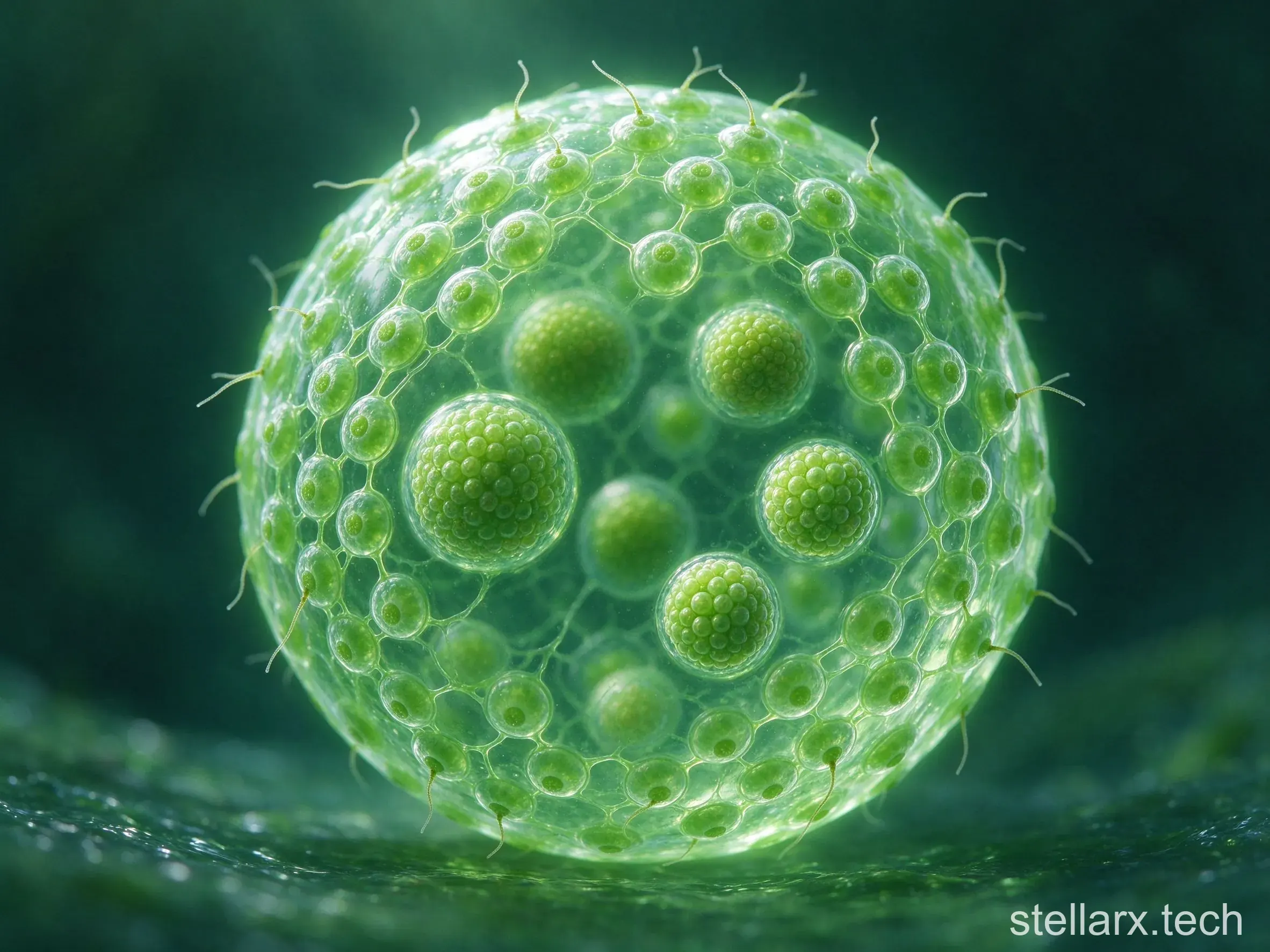
Volvox lives in fresh water and is visible to the naked eye: a green sphere up to a millimetre across, rolling slowly through the water. The sphere is hollow. Cells sit on its surface, anywhere from a few hundred to fifty thousand of them, connected to one another by cytoplasmic bridges.
That sounds like a multicellular organism. The question is how real its multicellularity is.
Volvox has two kinds of cells. Most are somatic: each carries two flagella, does the swimming and does the photosynthesis that powers the whole sphere. These cells cannot reproduce. They live, they work, they die, and their genes are not passed on. A minority are reproductive cells, much larger, which produce the next generation. They develop inside the sphere, form new spheres, and are eventually released from the mother colony to begin the cycle again.
That separation between somatic and reproductive cells is a big deal in biology. A somatic cell is committed from the moment it is born to serving the whole, with no descendants of its own. That sacrificial division of labour is one of the defining features of multicellular life.
The reason animals and plants could evolve complicated bodies is precisely that most of their cells gave up the right to reproduce and became part of a tissue. Volvox has crossed an important threshold in that sense.
Its close relative Chlamydomonas is a fully single-celled organism, each cell living and reproducing on its own. Between Chlamydomonas and Volvox sits a series of intermediates, Gonium and Eudorina among them, with rising cell numbers and rising degrees of division of labour. That lets scientists watch the origin of multicellular life almost frame by frame.
The dispute follows from exactly that. Is Volvox truly multicellular? Some say yes, because it has irreversible cell differentiation and a division of labour. Some say no, because its somatic and reproductive cells are genetically identical, differing only in gene expression, and because the colony's cell number and shape remain simple — a long way from real tissues and organs.
Others argue that multicellularity is not a yes-or-no property at all but a continuous spectrum, that Volvox happens to sit somewhere in the middle of it, and that forcing a label on it is a false question.
Taxonomically there is no argument: Volvox is a genus in the green algae. But the green algae are the ancestral group of plants, and Volvox itself is not a plant. Its multicellularity and plant multicellularity evolved independently, with no common origin.
In fact multicellularity has appeared independently at least twenty-odd times in the history of life. Animals, plants, fungi, brown algae and red algae each went their own way and each ended up with multicellular bodies. Volvox tells us that multicellularity is no great barrier: given the right conditions, evolution will find that road again and again.
Three answers to one question
A virus that is bigger than the bacteria it was mistaken for, a cell that photosynthesises like a plant and swims like an animal, a sphere that is either one life or fifty thousand: none of them fits the boxes cleanly, and all three are still out there, doing what they do.
Classification is a habit that living things keep failing to respect.
If you want to see what that looks like at eye level, WWAI puts a virtual microscope in front of a biology tutor, so you can ask about the cell in front of you and then look at it: including a Euglena specimen, where the chloroplasts sit as green bodies inside the cell, the red eyespot marks the front end, and the flagellum trails away from the body. Search WWAI in your app store to begin.
Related reading

Dinoflagellate Genome: Largest on Earth

- Inguinal Hernia: A Groin Bulge Mistaken for a Muscle Strain
- 腹股溝疝氣:產後健身鼓起的腫塊,卵巢掉進去了
- Four Days of High-Fat Diet Can Rewrite Skin Immune Memory
- 高脂飲食 4 天,皮膚發炎為何更猛、還記得住?
- 脂肪肝盛行率:中國每10個成人有3個
- Fatty Liver Overtook Hepatitis B: 3 in 10 Chinese Adults
- "Can you change the male lead to Zhou Jin?" — Female-lead melodrama audiences no longer settle for the answer you hand them
- 「能不能把男主改成周進」:女頻虐戀的觀眾,已經不滿足於看你給的答案
- Can you work overtime?" — 646 likes demanding the next episode, and the creator answered with something colder
- 「你能不能加班啊」:646 個讚在催更,作者回了一句更冷的
全部评论