Royalty Trope: Why Palace Romance Still Works
Two things are happening on the same shelf this autumn. On BookTok, BookTok romance has reorganised itself around the royalty trope, now one of the dominant structures in romance and romantasy — a whole reading list can now be organised around courts, crowns and people who are not allowed to say what they feel. In translation, the supply side has changed too: by the end of 2025, Chinese platforms had exported more than 130,000 online literary works and counted roughly 250 million registered readers outside China, with active readers in over 200 countries.
Neither number explains why anyone finishes a chapter at two in the morning. A structure does not hold a reader; a specific person in a specific room does. So this is not a survey of the genre. It is one book, read closely enough to see why the machinery works — and honest about where the excerpt stops.
Why a crown is a better plot device than a locked cabin
Most romance tropes create constraint through situation. Forced proximity puts two people in one room. Fake dating makes them lie in public. Enemies to lovers turns friction into fuel.
The royalty trope does something different: the constraint is built into who the characters are. A king can command armies, dispose of wealth, and be obeyed without argument, and still cannot simply take the one person the story withholds. That inversion — absolute power sitting next to absolute helplessness — is the engine.
A court makes it worse, in the useful sense. Courts are theatres by design: every corridor has an audience, every gesture is read, every sentence is a diplomatic act. Characters cannot say the plain thing. They bury it under etiquette. The slow burn lives in the distance between the face shown to the hall and the face shown in an empty room. A slow-burn romance is made almost entirely of that distance, and the royalty trope is the cheapest way to manufacture it.
A cook, a scar, and an emperor who only trusts her cooking
The book is Ugly Slave Aman, a palace romance told in the first person by the woman everyone in the imperial kitchen calls the ugliest cook on staff — and the luckiest.
The luck is a piece of history. Years earlier, when Xie Linchuan was still an unfavoured prince whose mother was confined and slowly starving, Aman was a kitchen apprentice sneaking him lotus-seed soup and lotus-shaped pastries that looked, by her own account, like clay. He ate them anyway. Later, when he was made crown prince and the remnants of the defeated princes sent an assassin, she was the one who stepped into the blade. She is short, so the sword meant for his heart went across her right cheek instead. That scar is the first fact of her life, and the thing he touches when he wants to be cruel in a tender voice.
The book opens on the day the arrangement breaks. He is emperor now. At a palace banquet, the Imperial Concubine remarks that the dishes are a little greasy. He covers his mouth with a handkerchief, spits out what he is eating, and says, coldly, that it is indeed greasy — that being ugly is one thing, but serving food this unappetising is an eyesore to the Concubine. Then he waves a hand and has her dragged out for fifty slaps to the palms.
That night, hands swollen round, she is comforted by Granny Li, who is retiring from palace service and has a nephew back home, a rough man but reliable. Aman looks up, wipes her tears, and agrees: she is twenty-five; it is time for a husband, children and a warm bed. She will leave the palace and find a man.
The humiliation is the plot, not the decoration
What follows is not a misunderstanding that could be cleared up in one conversation. It is a sequence of small, deliberate cruelties, each one narrowing her options.
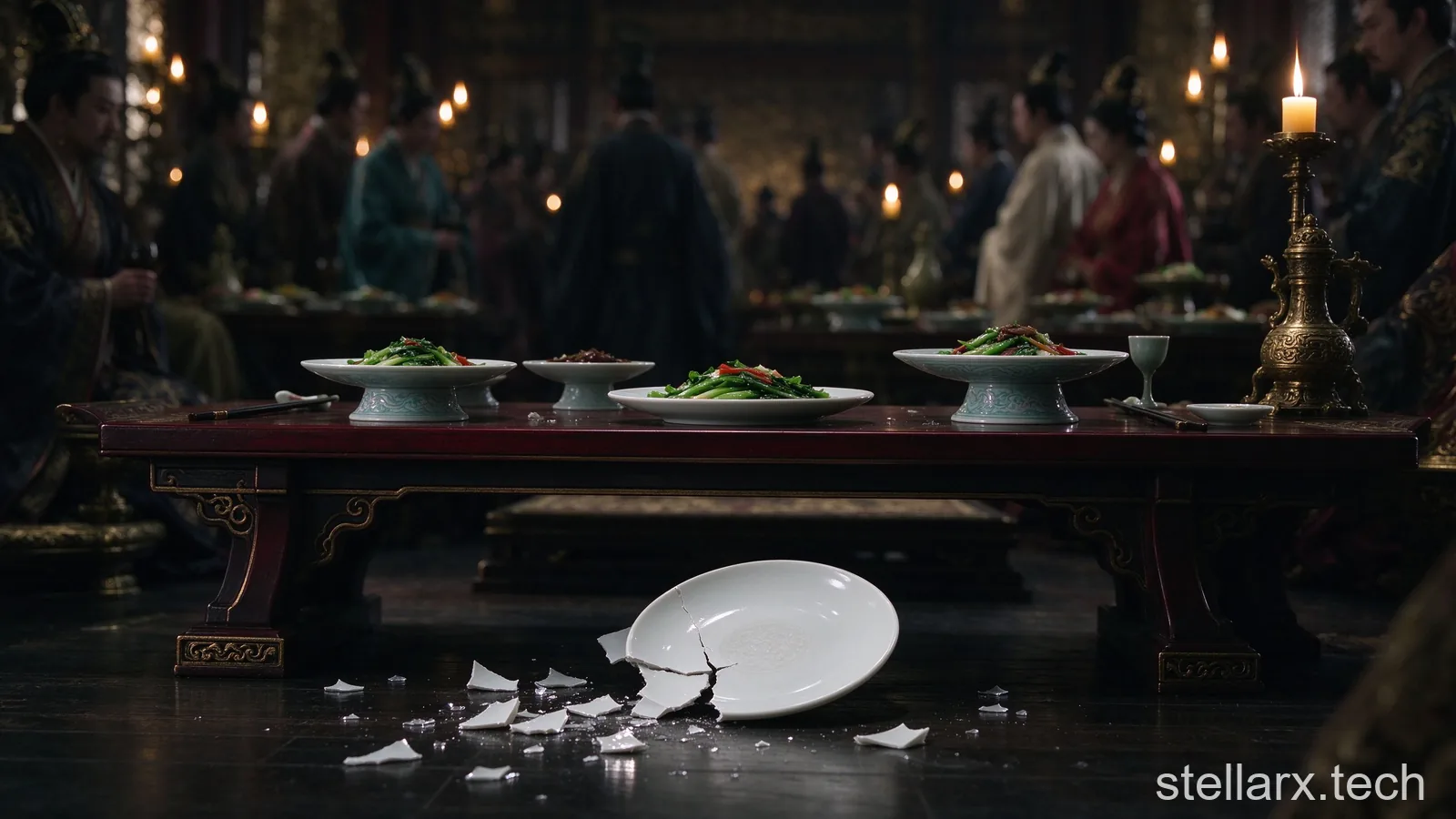
Sent to deliver lotus-shaped pastries to the imperial garden, she finds him admiring the lotus with the Concubine. The Concubine's nail guards press into the welts on her hand; the pastry box is snatched; the plate is smashed; the pastries are declared too ugly to look at, and the two of them walk away arm in arm. Later, when she tries to raise the subject of leaving, he cuts her off — one should not speak while eating — and orders a few more slaps, to teach her the etiquette of service and to temper a spoiled nature. Behind her back, his personal eunuch marvels that this is the first time he has seen His Majesty eat food prepared by someone else. The Concubine offers to send dishes daily. He says, softly, "Hmm."
That "hmm" is the whole turn. She hears it, and knows the last shred of special treatment is gone. The scene is not there to make him a villain. It is there to show a man who can keep a person alive on his attention and also withdraw it as policy, in front of witnesses, without ever raising his voice.
Her counter-move is the least romantic possible: paperwork. Granny Li points at the Imperial Household Department; Aman bribes the head steward, Li Dequan — the boy who once starved alongside Xie Linchuan in the Cold Palace — with peach cakes and a fistful of melon seeds, and gets her name onto the list of those leaving the palace in four days.
What this heroine does that most palace heroines don't
Most palace stories give the heroine a talent for calculation. Aman's talent is labour and memory: she knows who went hungry, she knows what a cold room tastes like, she can make a bowl of soup that a future emperor remembers for a decade. Her leverage is not intelligence over other people. It is having once been useful to the right person at the worst moment of his life.
Which is also why the danger works. A person like that is needed and dispensable at the same time. When the Concubine catches her outside the Imperial Household Department, the accusation is exactly this: currying favour, guessing at the emperor's preferences, wanting to be an equal. The punishment is a foot on her back, a dislocated shoulder, and a lotus pond — thrown in, pelted with stones when she tries to climb out, then a basin of snakes poured into the water. The last line of the excerpt is someone running with a lantern, shouting that His Majesty has arrived.

The cliffhanger is the form, not a trick
That is where the text stops. A chapter ending mid-rescue is the standard device of serialised fiction, and it has a cost: it works only if you care about the person in the water. The reason this one lands is that the previous twenty pages spent their time on small physical details — a scar, swollen hands, a smashed plate, a bowl of soup — instead of on politics.
For readers who want to test a serial before committing, three habits help. Read to the end of a scene rather than the end of a chapter, so you judge the writing and not the hook. Notice what the chapter withholds — here, whether the emperor's cruelty was policy or panic. In a slow burn romance the withheld thing is usually a sentence rather than an event, and the pleasure is in watching someone almost say it. And keep a note of the one physical detail that keeps returning; in palace romance, that object is usually the real argument.
Where to continue reading
Ugly Slave Aman is one of the palace romances in Wwai, a mobile fiction reading app with a multi-genre library — royalty, arranged marriage and slow-burn court drama sit alongside contemporary and supernatural titles, and the stories unfold chapter by chapter rather than arriving as a finished block.
If the scene above left you in the water, the rest of the chapter is one tap away. The card below opens the story in Wwai.

References
Bookdot Blog. Royal Romance Books: The Best Royalty Trope Reads for Every Fantasy. 19 May 2026. https://bookdot.app/blog/royal-romance-books-royalty-trope/
Xinhua. China Focus: China's online literature grows in scale, expands global reach. 30 July 2026. https://english.news.cn/20260730/ed3c56790ec74da39400262ee9fcd390/c.html
People's Daily Online / China Daily. China's novel approach spreads its web. 20 March 2026. https://en.people.cn/n3/2026/0320/c90000-20438234.html
- Salt: Why the Plainest Seasoning Works on Every Food
- 鹽:最平凡的調味料,為什麼什麼菜都需要它?
- 长大以后,我们还能再去一次少年宫吗?
- Royalty Trope: Why Palace Romance Still Works
- 王族題材為何耐讀:宮廷羅曼史的慢熱結構
- H5N1、麻疹與疫情復燃的生物學
- H5N1, Measles and the Biology Behind Outbreaks
- A Planned Hair Color Preview Would Compare Colors on Your Photo
- 換髮色功能規劃用自己的照片比較不同顏色
- A Planned Face Shape Poster Brings Analysis and Styles Together
全部评论